Garden

Garden Chores for the Month of May

The month of May has arrived….and what a busy month this is in the garden!

The gardens are coming alive and there is much to be done.

But remember the old adage-

In the middle of May comes

the tail of winter. 

So while you are enjoying the beautiful spring weather, remember to have your fleece cloth handy for that unexpected freeze.

I garden in the mid-Atlantic region, which is zone 5-6.  The last expected frost for this region is the middle of May, usually around Mother’s Day, but we are not entirely frost safe until the end of May, or around Memorial Day.  So, plant accordingly.

Here is a list of some things that can, and probably should be done in the garden this month-

  1. Perennials can be planted.  This is also the time to dig and divide any overgrown perennials, such as hostas and daylilies.
  2. Tender summer blooming bulbs, such as dahlias, gladiolas and canna lilies can be planted out after the last frost.
  3. After the spring blooming bulbs have flowered, remove the spent flower head but leave the foliage until it dies back naturally.  Wait to cut off the leaves until they have turned brown.
  4. Harden off your seedlings. Any seeds that have been started indoors should be potted up and can be taken outside on nice days to begin hardening off so they are prepared to be planted out.
  5. Warm season flowers and vegetables can be direct sown in the ground after the last frost.  For vegetables, these would be green beans, corn, cucumber, pumpkin and squash.  For a longer harvest window you can plant short rows of each every 2-3 weeks for a longer successive harvest.
  6. House plants that have spent the winter indoors can be taken outside on nice days to get acclimated to being outside again.  Put them in a sheltered area and do not put them in direct sun.  You can begin fertilizing them now.  Any pot bound plants need to be re-potted up.
  7. Window boxes, planters and pots, as well as flower beds can be planted up with tender blooming annuals after the last frost date.
  8. Prune any trees and shrubs that need help. Remove all dead, diseased or crossing limbs.
  9. Prune back the spring flowering shrubs after they have finished blooming to keep them compact such as lilac, forsythia and quince.
  10. Prune and shape any evergreens if needed.
  11. Prune and fertilize roses.
  12. Begin mowing the lawn.  Leave the grass cuttings to provide nitrogen. Re-seed if needed. Now is the time to spread any ‘weed and feed’ product on the lawn.
  13. Set up supports as needed.  In the vegetable garden-tomato supports and trellis for climbing vegetables.  In the flower garden-trellis and supports for climbing plants such as clematis.
  14. If you use an irrigation system, get it set up and tested before too much growth has taken place.
  15. Make sure that newly planted seeds are kept watered.
  16. Regularly harvest the rhubarb and asparagus.
  17. Do any thinning of early spring sown vegetables.
  18. Put up hummingbird feeders.
  19. Keep up the regular maintenance of the the yard and garden.  This includes weeding on a regular basis.  Try to keep after the weeds while they are just starting to grow and still small. The object is to not let any weeds go to seed.  Weed pressure is highest in the spring and early summer, and if you can keep after them, it will not be so bad later in the season.
  20. Fertilize as needed.
  21. Mulch as needed.  Do not apply mulch until the ground has warmed up sufficiently.  Keeping the garden mulched will cut back on so much work later on.
  22. If you haven’t already, start and keep a garden journal.  Also, take regular pictures of your garden.  It is amazing what you can’t remember from year to year and photos are a big help.

More work now will mean less work later when the heat of summer is here.

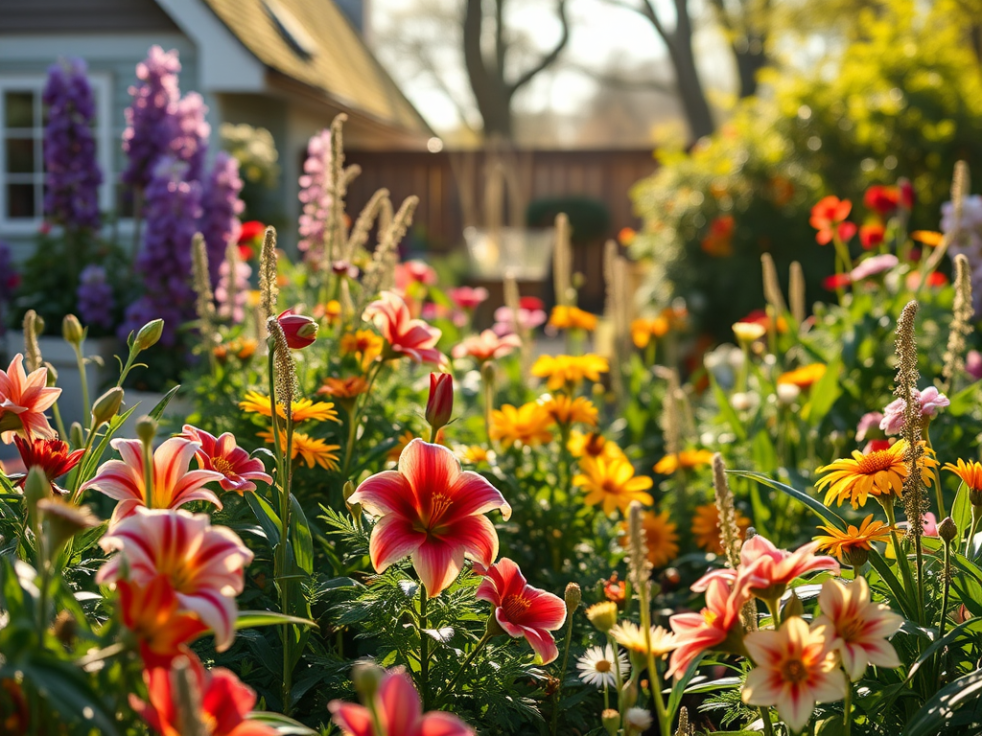
( AI generated photo)

So, enjoy the beautiful spring weather while it is still not too hot.

Take time to savor the sights, sounds and smells of May.

A Prayer For Spring

Oh, give us

pleasure in the flowers

today.

And give us not 

to think so 

far away

As the uncertain

harvest.

Keep us here

all simple in the 

springing

of the year

Robert Frost

Happy Gardening!

Margie

Garden

Fridays Flower-Primrose

Primrose


Primrose Stirs, Lifts Up Her Head
Stands Up Tall, On Softened Bed
Resurrected, As Winter Dreams
Primrose Smiles, Or So It Seems


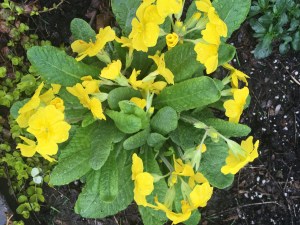
Blooming primroses are such a bright, cheery sight in the spring.  They do make my heart smile when I look at them!


Primroses are a perennial plant, coming back every year, making an ever bigger clump.  They grow from fibrous roots.
Primroses bloom in the early spring, sometimes blooming sporadically through the summer.
Do you grow primroses?
*
Matthew 6:20,21
But lay up for yourselves treasures in heaven….
for where your treasure is, there will your heart be also.
*
I will be digging and dividing my primroses this late spring/early summer.  The colors that I have are the ones in the photos above-true yellow, and a dark pink with a yellow eye. If anyone would be liking a start of them, just let me know in the comments and I will get it to you!


Garden

Fridays Flower-Hyacinth

Spring Hyacinths

spring hyacinths

Hyacinth-one of the early spring blooming flowers.

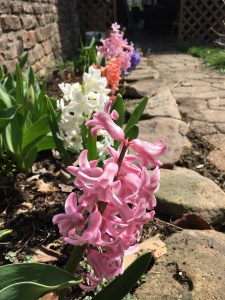
What a welcome the blooming hyacinths are, for their rich color and wonderful fragrance!

Hyacinths are very easy to grow, requiring very little care, but so rewarding after a long, cold winter.  They are the essence of the fragrance of spring, blooming about the same time as daffodils and tulips, March to April.

Hyacinths grow from large bulbs that should be planted in the fall, usually in September to October, any time after the first light frost but before the ground freezes they can be planted.

Bulbs can be purchased at your favorite big box store or ordered from seed or nursery catalogs.

Hyacinths are hardy from zones 4-8.

They do best in full sun but will still flower in partial shade.

Hyacinths come in a wide range of colors from white, peach, apricot, salmon, blue shades, yellow, pink, red to purple and lavender.

Hyacinths grow to 6-12 inches tall, with a dense flower spike surrounded by strap like leaves.

The bulbs should be planted 4-6 inches deep with the pointed end up and 4-6 inches apart.

They like rich loose soil that is well drained, and only need water when dry.

Hyacinths do not multiply and spread like daffodils.  One bulb per flower-the bigger the bulb the better.

Hyacinths tend to decline over the years-some people treat them as annuals and replant new bulbs every fall, but if left alone they will bloom for many years, just not as pretty and lush as the first year. The faded flowers should be cut back as soon as they begins to turn brown, and the leaves left to grow.  The leaves will store energy for next years bloom.  When the leaves brown off they can be cut back or gently pulled off.  Some compost or fertilizer is appreciated at this time.

Hyacinths are best at the front of flower borders.  Emerging perennials will hide the dying foliage.  They are lovely lining a walkway where their fragrance can be enjoyed.

Hyacinths make good cut flowers and have a long vase life.  They can also be planted in containers, or forced for indoor winter/spring blooming.

One warning-the bulbs are poisonous-they contain oxalic acid, so use care while planting and around children and pets.

I am enjoying the beautiful colors and fragrance of my hyacinths this spring.  In the photo above is one of the beds that I made at our new house.  The stone wall on the right was already here-I made this flower bed, bordered by my signature stacked stone borders from stones that I have gathered over the years. Seems like every time I was digging I ran into stones-I decided to put them use as border stones.  Now I look for stones everywhere, and have been known to stop the car and grab stones from along the side of the road.  No stone is safe around me if it is the right shape and size!   Also the stepping stones were brought from our last house and reused as a walkway between the stone patio and stairs to the deck.

The garden here is a work in progress, and I am enjoying the progress of it!


Poem by Gerald Green


HYACINTHS PERFUME

I lingered to enjoy the moment,
ending the eleven-month intermission,
as the sweet aroma reached me
from the garden behind the house.

The hyacinth had returned
without fanfare or recognition
by bulbs not yet broken forth,
or buds pregnant with the glory of spring.

I followed the unforgettable scent
to its humble position beside the hellebore,
and admired my early spring friend
before me in perfect health.

With one whiff, everything changed.
Last year’s faded images of spring renewed,
and the value of life increased
in a moment. In a breath.


Garden

Winter Surprise

February…what a teaser!

We have struggled and endured the stunningly cold polar vortex that assaulted us for a number of days in late January and early February….then February decided to give us a taste of spring with warm breezes and sunshine.  We are now back to cold and blowing snow.

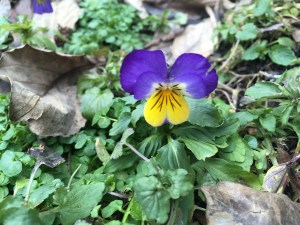
While walking to the house with my head tucked from the cold wind, and not paying much attention, I glanced down and couldn’t believe what I saw…the little violas that had reseeded along the sidewalk were blooming!  Such an unexpected surprise!  February is teasing us again!  But spring will be here soon.

The flowers of late winter and early spring 

occupy places in our hearts

well out of proportion to their size.

Gertrude Wister

*

Philippians 4:4

Rejoice in the Lord always;

again I will say, rejoice!


Garden

Flower of the Week-Johnny Jump Up

Johnny Jump Up

What a name!  But the flower does its name justice.  Such a cute name and such a cute flower.  Such a happy smiley face of a flower.
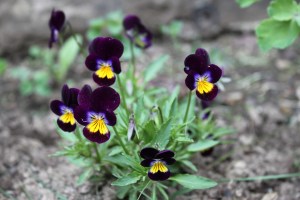
When we moved to this new house last fall, I found lots of these Johnny Jump Ups all over, in the lawn and in beds.  I tried transplanting some of them from the lawn into beds where I wanted them.  Most of the transplants did not live over the winter, but this spring, there were plenty more to move where I wanted them.  I had never grown violas before and I am loving them.

So, here is the scoop on Johnny Jump Ups…

Violas, known as Johnny Jump Ups, are a popular, easy and fun to grow flower. They are also known as wild pansy, which they are related to, (the size of the flower being the difference) and as heart’s ease.

Violas come in the cheery colors of deep purple, mauve, and yellow.

They love the full sun, and will also do well in partial shade.

Violas can be planted in the summer or fall, by scattering the seeds on the ground and then barely covering them. Keep watered.

They like average garden soil, but some compost never hurts anything.

They will germinate in about 10 days.

Violas are long blooming, blooming from spring till the fall if they are kept deadheaded.  When the plant becomes worn out, cut it back to about 3-4 inches for a re-bloom.

Violas are low growing, about 3-10 inches tall and are good for the front of flower borders.

Violas can be self seeders, as the ones I have are.  If they are not deadheaded, the seeds will scatter as they will.  Just dig a good size clump and move them where wanted.

They like to be kept well watered and weeded.

Violas are not bothered by disease or pests and are frost tolerant.

Violas are edible-they can be used as a garnish to decorate cakes and pastries, added to salads, and frozen in cubes to float in summer drinks.

I am enjoying my happy face Johnny Jump Ups.

Do you grow violas?

*

Colossians 1:10

That you may live a life worthy of the Lord

and may please him in every way;

bearing fruit in every good work,

growing in the knowledge of God.