

Peas are one of the first crops that you can sow in the vegetable garden. They are also one of the easiest vegetables to grow.
Most peas are ready to harvest in 50-70 days after sowing. A second planting of peas can be made 2-4 weeks after the first one and the harvest can be extended. They are a cool weather loving vegetable so are best planted in the early spring. Peas can even handle a late snow and even some freezing temperatures. Peas need to mature while the weather is cool. They can also be planted as a fall crop when the summer heat has abated.
How to Grow Peas
Location
Choose a sunny location with at least 6-8 hours of sunlight.
Soil
Needs a well-draining soil. Amend the soil with compost or well aged manure before planting. Do not over fertilize. This will create excessive foliage growth over pea production. Peas are light feeders. Peas are also nitrogen fixers-putting nitrogen back into the soil. Heavy feeding vegetables can be grown when they are done.
When to plant
Plant as early as possible in the early spring, about 6 weeks before the last projected frost in your area. I grow in zones 5-6, and this is usually in March and April. Raised beds are ideal if your spring is long and wet. If planting peas as a fall crop, plant 6 weeks before the first projected frost for your area.
How to plant
Peas do not like their roots disturbed once they germinate and are best direct sown in the ground. This is a good reason to have the ground cleared and ready to plant in the fall.
The seeds will germinate in about 6-17 days. The pea seeds can be soaked in water overnight to help them germinate sooner, but it is not necessary. The temperature of the soil should be above 40 degrees. If the temperature is too low, it will take the seeds longer to germinate.

Plant your pea seeds in a furrow 1-1/2 inches deep and 1-2 inches apart. Do not thin the seedlings as they emerge. Rows can be planted 12-24 inches apart.
How to grow
Most pea varieties, even the bush type, need some type of support. It is best to keep the foliage off the ground and it makes the peas easier to harvest. Have the supports in place before you plant so as not to disturb the fragile roots. Peas can be grown on a trellis, chicken wire, stings or netting. Tree branches and twigs can also be used as a support. Plant a row of seeds on each side of your support or trellis. Bush varieties of peas grow 18-30 inches, while pole varieties grow as tall as 4-6 feet.
Weed the peas gently and mulch to keep weeds from growing and the soil temperature down. Keep the peas watered.
Companion Plants
Peas grow best with beans, coriander, corn, cucumbers, radishes, spinach.
Peas do not like garlic, onions and potatoes.
Crop Rotation
Do not grow peas in the same location for 3 or 4 years.
Harvesting
Pick your peas as soon as they are ready and early and often. It is best to pick peas in the morning after the morning dew has dissipated. Use two hands to pick the peas-one hand to hold the vine and the other hand to pluck the pea pod off.
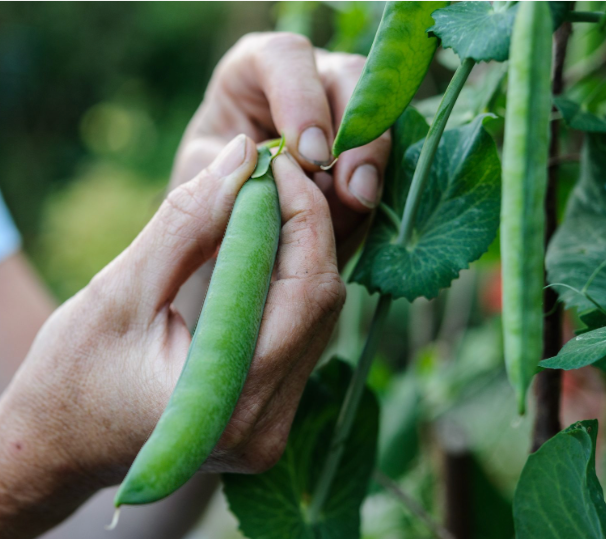
Cool the harvest quickly. The peas can be keep in the refrigerator for about 5 days and you can keep adding to them until there is enough to eat.
Peas can be eaten raw-they are a nice treat freshly picked while out in the garden. They can be eaten as a raw snack and in salads. They can also be used in pasta dishes, soup, casseroles, and stir fry’s.
When the plants begin to turn yellow, it is time to cut them off at the ground. Leave the roots in the ground to provide nitrogen for the next crop.
To preserve your pea harvest for later in the year, it is easy to freeze them. Shell the peas, blanch in boiling water for a few minutes, immerse in cold water, then drain and pack into plastic bags and freeze.
Varieties of Peas
There are 3 basic varieties of peas.
1. English or Sweet peas. These peas have an inedible pod and need to be shelled.
2. Snow peas. They are flat, stringless and the whole pea pod is edible.
3. Sugar Snap peas. Thick edible pods that contain full size peas.
There are also a variety of yellow peas and purple peas.
The History of Peas
Peas are traditionally planted on Saint Patrick’s Day.
Peas, being quick growing, were the vegetable of choice for the genetic research done by a monk named Gregor Mendel in the mid 18th century. His experiments led to ground breaking genetic research in the Laws of Inheritance, the Laws of Dominance, the Laws of Segregation and the Laws of Independent Assortment.
Have you ever grown peas? Are you planning on growing peas this year? Comment back and let me know how your pea growing went!
….Winter, will be forced
to relent, once again,
to the new beginnings of
soft greens, longer light,
and the sweet air of spring.
Madeleine M. Kunin

 margiesgarden.com